Saturday, January 7, 2012

The Softer Side of Sears

I know people who pride themselves on the fact they do not own a TV set, or watch TV, or are unaware of anything going on in the world of popular culture.

I am not one of those people. Popular culture is my daily bath water, and TV is the faucet. Not only do I enjoy television, but I revel in the cultural benchmarks of television commercials -- especially ads with catchy jingles and motifs.

Of all retail outlets in the United States, no other company has wrapped itself up more in commercial promotion than Sears. For over a century, Sears and its marketing department set the retail consumer tastes of the nation, selling items as disparate as blue jeans and do-it-yourself house kits. During its heyday, Sears was the Amazon.com of its time, and retained that status through most of the 20th Century.

Sears television marketing has faded since it was purchased by K Mart Corporation, but the decades preceding the merger presented a fantastic array of 30 and 60-second entertainment lozenges. They're short time capsules of  what the folks at one of America's largest retailers thought we'd be persuaded to buy.

The earliest Sears commercials I can remember were for Sears Toughskin jeans. Although I was a Wrangler kid, I knew quite a few guys my age in the 60's who wore the outrageous pumpkin-colored polyster jeans made from the same material that formed the surface of trampolines.


Polyester pants, for exercising in the hot summer sunshine. And people bought this idea!

As the 60s and 70s gave way to the 80's, the focus of Sears marketing moved away from selling moms on the idea of kids' rip-proof clothing and tried to capture more male shoppers. The theme was "There's More for your Life - - at Sears." Here's a mid-80's commercial trying to show that hanging out at the mall on a Saturday while your muffler was getting replaced was a GUY thing:


The problem was that this "guy thing" ad campaign was a bit *too* successful. Women associated Sears with Craftsman tools and sweaty Sears technicians changing tires. In 1993, Sears rolled out a completely new campaign - - a campaign that would span the rest of the 1990s: "The Softer Side of Sears."

Depending on the source, everyone from Jim Brickman to Jake Holmes composed ditties touting the great variety and quantity of high-fashion women's wear at Sears. The commercials were packed with runway models playing with little kids and twirling around in prom dresses while the catchy C-F-G-C melody played over the stylish scenes. The jingle lyrics played on words that normally described the traditional hardware/appliance inventory of Sears: "electric pumps" now referred to bright red high-heeled shoes, and "plungers" could also describe some women's formal wear.


These folks didn't look like typical Sears customers. They were fashionable, carefree, and seemingly a lot more well-off than folks you'd bump into buying a gallon of Weatherbeater paint.

The campaign also tried to key in on loyalty between customers and the retail chain. Sears was a familiar name across the entire country, and the familiarity of what Sears had always provided in reliable merchandise was also underlined in these ads. Here's an institutional ad that sells more than just the products, but the Sears brand ID itself:


By 1999, Sears discovered that this campaign also over-successful. Women headed to Sears for high-fashion clothes, only to find that the selection of cotton housecoats and ill-fitting stretch pants never really changed. Unlike the marketing department's plans for fashion domination, Sears's wholesale buyers never upped their game by loading the shelves with a better line of clothes. Sales declined for the final three years of the 20th Century, so Sears moved on to a bunch of new ad campaigns, none of which were directed at getting people to believe that buying clothes at Sears was a great fashion choice.

Sears / K Mart has a muddled marketing message nowadays. I'm not sure I remember the last time I saw a memorable Sears ad. It's a shame, because the tradition of smart, fun commercials had a long history at Sears.


Wednesday, January 4, 2012

The 1% TV Dads

For the past week or so I've been working on an article for TVDads.com about wealth and poverty among the single dads on television. I've been meaning to tackle this topic for quite a few years, but I've decided that the era of Occupy Everything may make this the perfect moment.

I don't want to spill too much about the content, but one of the topics is about where individual TV Single Dads land on the wealth-o-meter for their locales. It's surprisingly difficult to measure some of these television dads in an appropriate manner. Yes, Bruce Wayne is rich and Fred G. Sanford is poor - - but what about Papa Smurf? Is the blue guy rich, poor, or average? Should he be compared to other Smurfs, or Gargamel? What about Man-at-Arms on "He-Man and the Masters of the Universe?" He's a civil servant on the planet Eternia, but how well-off is he compared to others on that planet?

All these calculations are beginning to be quite a struggle, but I hope to have the article finished by the end of the week. Expect an update soon.

Saturday, December 31, 2011

Unfinished Business

For the past few years, I've been trying to get more things done in my life by writing out a yearly "To-Do" list in my journal (if you don't have a bound journal, get one - - it worked for Pepys and it works for me, too). The downside of the To-Do list is that, at the end of each year, I have a thorough and accurate record of the things I didn't accomplish.


Top of the Unfinished pile is my Sekrit Space History book. I'm barely 40 pages into an expected 290-page book, and its completion keeps getting moved down the priority list. If I don't finish this epic by the end of 2012, I'm going to miss a lot of 50th anniversary events that tie into the narrative. So that's a key item to focus on for the coming year.

Second missed goal was my emptying of the End of Raiders of the Lost Ark basement. I've dumped a half-dozen crates into trash bags and shredders, but the stack o' stuff still clogging my cellar needs to go. It's at the point now where I don't like going downstairs because I'm reminded about how much stuff needs to be sorted, sold, donated, or trashed. However, 2012 is now my fire sale date for ditching the detritus.

TVDads.com was supposed to be on the Drupal content management system by now, but I've been working so much on paying gigs that my web equivalent of the cobbler's children is still without shoes. Perhaps I can tackle this after my current client gig is up, but before the 2012 Fall Season announcements arrive.

Of low priority but long overdue, my never-ending critique website of Ross Hunter's Airport movie remains stalled at 0:15:00. As with the TVDads upgrade, too many events took priority above its completion. I think I can solve this by devoting a solid weekend to typing and frame-grabbing. The big decision, of course, is to figure the right weekend.

Other than those goals and a few minor missed opportunities, 2011 has been a smashing success. I received my Master's degree, my daughter graduated with honors at the University of Rhode Island, my son ejected from his frustrating job to go to work at a place where they respect, love, and (most importantly) PAY him for his talents and labor. My girlfriend has also left her frustrating job and moved closer to completing her own degree.  Our family ends the year generally happy and definitely healthy.

I'm thankful most of all for having so many friends in my life. When days are filled with work and study, it's easy to become isolated from the rest of the world. Fortunately, the people I know and love and who know and love me keep me connected and share their lives with me every day. If the question is "what are you most grateful for in 2011?" the answer, of course, is you.

Have a great 2012. See you there!

Monday, December 19, 2011

Backyard Lucas

A million billion years ago when I was young, I used to make animated movies - - not the kind with the acetate sheets on a drawing board, but actual 3-D, stop-motion films. With a bucket of Matchbox cars, a Super 8 camera and a cable release (something that the camera guy at Woolworth's couldn't understand: "Why would you need a cable release for a movie camera?"), I'd film stop-motion traffic jams in my backyard as long as the summer afternoon light lasted. Pixelated GI Joes in Mercury spacesuits would be tethered to the "orbiting space platform" that looked an awful lot like the family mailbox out by the curb. Hundreds of feet of processed film epics sit in shoeboxes somewhere in my house, each reel  a short lesson that taught me how to make the next film a little better.

I went to college to learn how to make professional, compelling films. Then I got married, had kids, and found other priorities that crowded out my early desire to tell stories with moving images. I couldn't go back to making films, because I didn't have time or budget to take care of what was more important in my life. Understand that I enjoyed the life that happened instead - - - I didn't think I'd ever be able to go back to making films like I used to.

In the past month, I've found out that there may be a way to make cool movies again. Since I'm now the CEO of a New England high-tech company, I can now experiment with the latest software technologies and equipment. One of these software technologies is the latest release of Adobe's AfterEffects program, a piece of software that comes pretty close to parking Industrial Light & Magic on your desktop. For troglodytes like me, the output from this software is nothing short of breathtaking.

Let me give you a brief idea of the level of coolitude brimming from this software. I ordered a copy of Adobe AfterEffects from Amazon early last week. It arrived Saturday and took about 10 minutes to install on my computer. After looking at a few brief tutorials online, I thought of a test subject to try as a first-go at learning the ins and outs of the program.

Here are the details: NASA's Jet Propulsion Laboratory has been receiving closeup photo data of the Moon from the Lunar Reconnaissance Orbit for more than a year now. Last spring, JPL published a high-resolution Mercator projection photo of the Moon. It looks like this:


One of the cool things Adobe AfterEffects can do is  take a flat picture and wrap it around a 3-D sphere, so that the result can be displayed as a virtual globe. So, I took the hi-res LRO picture, told AfterEffects to wrap it around a sphere, and then I spun the virtual sphere and told AfterEffects to move the virtual camera away from the virtual Moon globe. Here's the result:


That's just from an hour or so of playing with the controls and slapping one NASA pic into the photo asset directory. 

Now, I really *want* to make a short film with this amazing bit of software. First, though, I think I have to make it through Christmas first.

Wednesday, November 23, 2011

Remember Where We Parked!

If you've tried out my two previous blog posts on how to be a Moon map expert, you're now quite ready to be a Certifiable Lunar Historian when it comes to knowing where all the Apollo Lunar Modules landed. It's a snap, because (1) there are only six lunar landing sites and (b) the maria you already know will help you pinpoint the landing sites quite easily.

The Apollo lunar landing missions were numbered 11-17. If you saw the movie, you already know that Apollo 13 wasn't able to land on the Moon, so all we have to think about are the remaining missions: 11,12, 14, 15, 16, and 17.

Everybody knows that Apollo 11 landed in the Sea of Tranquility, and we'll get into more detail about that shortly. Let's split the remaining missions after Apollo 11 into "odds" and "evens" :


So, we've got the even-numbered missions on the lower left, the odd-numbered missions up above, and the Apollo 11 mission right in the middle as sort of a "divider." It's funny, but the layout is pretty darned close to how the actual landings occurred back then.

You know where Apollo 11 landed, right? "Tranquility Base," on the Sea of Tranquility. Let's go back to the Moon map and look at the Sea of Tranquility again:


As you remember, it's right in between the Seas of Serenity and Fertility, right? (STuF). The Sea of Tranquility straddles the Moon's equator, which is fortunate, because Apollo 11 relied on an equatorial orbit when it arrived at the Moon. Landing on the equator would make things a lot easier for fuel consumption and communications back to Earth, so Mission Control picked out a smooth spot on the Sea of Tranquility that's right on the equator. Let's look at the map with an equator drawn on it so you can see where the landing was:


See? Right on the equator, at the bottom left corner of the Sea of Tranquility is where Neil Armstrong and Buzz Aldrin landed. All you have to do to find the landing site when you're looking at the Moon is to find the Sea of Tranquility (which you know how to do already) and then look at the 7 o'clock position of the mare - - THAT'S Apollo 11.

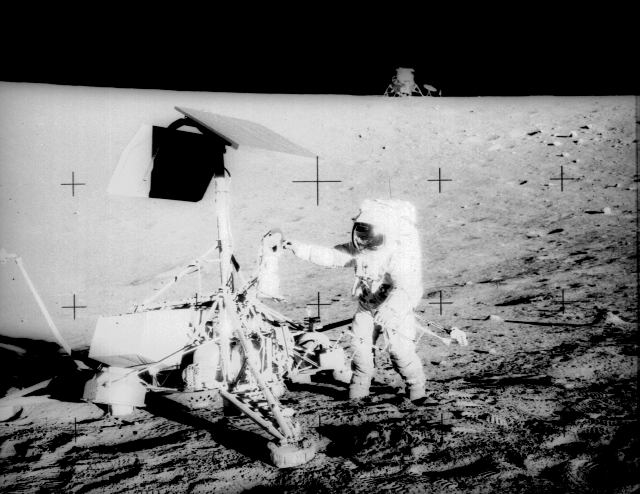
Let's go on to the next two landings, 12 and 14. Both of these ships landed in what's called the "Known Sea" or Mare Cognitum. The reason the sea was named the "Known Sea" is because so many lunar missions (manned and unmanned) arrived on this expanse of flatlands on the west side of the Moon. In fact, part of Apollo 12's mission was to set down next to an earlier unmmaned probe named Surveyor 3, a feat which Pete Conrad and Al Bean achieved in November of 1969:


The landing site for Apollo 12 was right where the Known Sea bumps into the Ocean of Storms, just south of the equator:
Once again, we skip over Apollo 13 because that mission didn't put anyone on the Moon, thank goodness. The next mission, Apollo 14, landed on the east side of the Known Sea, next to a huge, ancient crater called Fra Mauro. This mission was also south of the equator:

The final three Apollo missions were much more ambitious. While the earlier missions were near the equator and aimed for smooth, flat landing targets, the later Apollos were sent to the highlands of the Moon. The Apollo 15, 16, and 17 crews were outfitted with larger fuel capacity LMs, to fly further away from equatorial sites and carry more gear to the surface. They even had lunar rover vehicles with them to extend their surface activity areas. 

I'm going skip Apollo 15 for a moment so we can finish up the even-numbered flights. Apollo 16 landed in a highland area almost 10° south of the equator, near a rugged crater named Descartes. If you draw a line straight south from the bottom of the Sea of Serenity, the Apollo 16 landing site is about even with the north side of the Sea of Nectar:


Apollo 15 and Apollo 17, the only missions north of the equator, have easy-to-remember landing sites because they both landed next to the Sea of Serenity. Apollo 15 set down in-between the Sea of Showers and the Sea of Serenity, in an area called the Hadley-Apennine Mountains. It's really easy to spot if you look right at the middle of the northern half of the Moon.


The final mission landing site, Apollo 17, is as easy to spot as Apollo 15's locale, because it's also stuck at the intersection of two maria. In this case, Apollo 17 landed in the Valley of Taurus-Littrow, where the Sea of Serenity bumps into the Sea of Tranquility: 


And that's it! Just remember that Apollo 11 landed on the equator, all the even-numbered Apollos after that landed to the south and west, and all the odd-numbered missions landed to the north around the Sea of Serenity.

The crew of Apollo 17 left the Moon in December of 1972, and nobody's been back since. Hopefully there will be more landing sites to memorize soon, instead of just the six dots that mark mankind's furthest steps away from Earth.


Thursday, November 10, 2011

Be a Moon Expert! - Part 2

You're half an expert on Moon geography already - - so let's get the rest of the Moon into your head right away.

Quick technical review: the maria are the dark splotches we see on the Moon. The maria are spread out over the whole Moon in an easy-to-remember pattern:

"Five on the East Side,
Five on the West Side,
Two in the Middle
and an Ocean out West"


Last time, we went over the East (right-hand) side of the Moon, where there are FIVE maria: the Sea of Crises in the East, then then three "ity" maria in the middle East (Serenity, Tranquility, and Fertility -- "STuF," remember?), and then the Sea of Nectar, "dripping" at the bottom of the East side of the Moon.

Let's take a look at the Moon again:


Okay, we did the East side, and we'll do the West side - - but first, let's make a note of the two maria
that aren't East or West - - they're right in the middle, see?

Let's pull the Moon out of the background to make it clearer about how these maria straddle the centerline of the Moon:

They're a snap to remember. The north mare is Mare Frigoris - - the Sea of Cold. So, North - - North Pole - Cold, get it?
The second mare is smack dead-center in the middle of the Moon. It's called Mare Vaporum, the Sea of Vapors.


Now, I will tell you the incredibly stupid way I remember the name of this sea: "when you get a head COLD, you put Vicks Vapo-Rub on your chest." I came up with this memory aid when I was 8 years old, and it's been my personal shame to remember things like that for decades. Head Cold (up north where it's cold), then Vapo-Rub on the chest - - middle of the body, middle of the Moon. Sigh. Sad, but it's worked for me since the Apollo days.

Okay - - - remember where all the maria are:

"Five on the East Side,
Five on the West Side,
Two in the Middle
and an Ocean out West"


Let's press on to the West side of the Moon, okay?


Wow, that looks like a lot of maria, doesn't it? Fortunately, most of the dark part of the West side is taken up by the only named "ocean" on the Moon (the "Ocean out West") - - the Oceanus Procellarum, or the Ocean of Storms:


The way to remember the Ocean of Storms is to once again think of a US map - - the biggest ocean the United States bumps up against is the Pacific, which is in the Western part of the US. So, West... Ocean. And since it's the only "ocean" on the Moon, just remember that the name of the only ocean is the Ocean of Storms.

The Ocean of Storms accounts for almost half the "maria-type" surface of the West side of the Moon, so that brings the remaining maria in the West down to a more manageable number. Namely, there are only five more maria to remember. Let's look at the five remaining circles on the map of the Moon:
Okay, that looks like a lot of circles - - but you already know the blue one is the Ocean of Storms, so we just have to get the names of the five orange circles and we're done! Let's clear off the Moon and work on just the shapes:

So the first mare we'll deal with is the big round one at the top of the stack: Mare Imbrium, the Sea of Showers or the Sea of Rain.
There's an easy comparison you can make in your head - - the Ocean of Storms is HUGE. Mare Imbrium isn't as big as the Ocean of Storms, so it's just a "shower," not a "storm." Got it? Showers and Storms.

Okay, so the next mare on the stack is Mare Insularum -- the Sea of Islands.


Think of a rainy island, and you can remember that the islands are surrounded by the Ocean of Storms and the Sea of Showers. Another way to remember that it's a sea of islands is that there are some honking great craters scattered across it, like Copernicus and Kepler. We'll talk about craters next time, but right now just remember that the "islands" in the Sea of Islands are big craters.

This next mare is really difficult to remember, but I've kept it in my head with one of the stupidest metanymic memory aids ever conceived.

Mare Cognitum is the "Sea That Became Known" or The Known Sea. The way I remember this mare is that I *know* the mare below the Island Sea is the Known Sea. Yes, it's meta, but it works for me because I know the Known Sea is under the Island Sea. And now you know, too.

Here we go with the final two maria. As you can see from the places you've already learned, the places on the West side of the Moon seem to be concerned with weather - - storms, showers. The final maria are also about weather: namely, clouds and moisture. The mare on the bottom right is the Sea of Clouds, Mare Nubium.

The other mare is Mare Humorum, the Sea of Moisture.
How to remember these two? Well, on the Moon, "moisture is on the outside of clouds." Easy to see as the Sea of Moisture is closer to the edge of the Moon's horizon than the Sea of Clouds. Additionally, the Sea of Moisture is the lowest mare in the West - and so it's a drippy business, just like the Sea of Nectar, the lowest mare in the East.
Yes, the memory system is all quite infantile, but it seems to stick in the head if you give it enough time. Let's take a final look at where all these maria fit on the lunar surface:


Remember? The head COLD and the VAPO-RUB in the middle of the chest? Then, there's the only big Ocean, like the Pacific on Earth, that's way out to the West and is called the Ocean of Storms. 

Next there's the remaining five maria in the West - - the top one is Showers, which is like the big Ocean of Storms except Showers aren't as big as Storms. And it Showers on the Islands in the Sea of Islands, right in the middle of the West side of the Moon. And under the Island? Well, you KNOW that the Known Sea is under the Island, right? And you also know that the West is full of Clouds and Moisture - - but Moisture is on the OUTSIDE of Clouds on the Moon. Got it? Great!

Here's a look at what you know about the Moon:


"Five on the East Side,
Five on the West Side,
Two in the Middle
and an Ocean out West"

And you can name ALL of the maria now - pretty darned impressive! Next time, we'll go over some quick tips so you'll be able to point out ALL SIX Apollo lunar landing sites like a MOON BOSS. Failure is NOT an option. More soon.


Wednesday, November 9, 2011

You Will Be a Moon Expert in Five Minutes (well, half a Moon Expert)...

Thanks for coming back for the meat-and-potatoes part of the Moon talk. This episode, we'll get the map of the Moon memorized so that the next time you see the Moon in the night sky, you'll be able to impress your friends, family, and passers-by with your insanely-great knowledge of the Moon.

Here's the best part: you'll only have to learn HALF of the map of the Moon to be an expert. Why? You know this already: we on Earth only see one half of the Moon's surface. So, we'll only go over the NEAR side of the Moon. The FAR side - - the side we never see - - is mostly populated by hundreds of thousands of craters, like this:
And it's mostly a bunch of craters with really long Russian names (they were the first around the back of the Moon with a satellite, so hey -- naming rights!) so we'll just skip that part.

Okay, back to the Near side. When we look at the Near side of the Moon, we see mostly dark areas, punctuated by a couple of lighter, dusty cratered areas. Like this:


The dark areas are called by the Italian word for "sea," which is "Mare" (remember Galileo and his telescope? Hey -- naming rights!) The dark areas were given Italian names, and form the major identification structure of where things are on the Moon. It's sort of like talking about continents on Earth.

Now, it looks like there are a lot of mares on the Moon, and that might seem difficult to remember. However, if you break the Moon down into regions, it becomes super-easy to remember what is where on the map of the Moon.


First, a quick note about directions: when you're looking at the Moon in the Northern Hemisphere, north on the Moon is "up," south is "down," west is to the left, and east is to the right. So, let's think about it like this:


The secret to learn the map of the Moon is to learn this ditty about the Moon maria:

"Five on the East Side,
Five on the West Side,
Two in the Middle
and an Ocean out West"

Say it out loud. Don't worry - - nobody will notice. Say it:

"Five on the East Side,
Five on the West Side,
Two in the Middle
and an Ocean out West"

Okay, let's not learn the whole Moon at once - - we'll start with the East side of the Moon:


The East side of the Moon, the part that the New Moon first lights up at the start of the lunar month, has *five* major maria we can spot with the naked eye. Here's a bunch of circles to highlight the five maria:

Let's take the Moon away so we can focus on the maria circles:

So, there's one really circular mare on the upper right, three connected seas in the middle, and then a stretched-out one at the bottom. See the groupings? 1, then 3, then 1 more.

That one circle at the top right is the Sea of CRISES, or Mare Crisium.

See? You've learned the name of a lunar mare. Crises - - think of it as  NEW ENGLAND Crises, and it'll be easy to remember - -because it's waay up in the northeast part of the Moon, like New England is on a map of the United States. Crises - - you've got that one down pat now.
Let's get on with the clump of three. These are the "ITY" seas because their names all finish with "ity." Look:

There's the Sea of Serenity, the Sea of Tranquility (Neil! Buzz!), and the Sea of Fertility. Serenity, Tranquility, Fertility. How to remember this stuff? STUFF. Stuff - that's it! STF - Serenity, Tranquility, Fertility. Think of it as a sandwich - -the STUFF goes in the middle.

Last one on the East side of the Moon is the Sea of Nectar:

Nectar - - how to remember that? Nectar DRIPS down to the bottom, so the Sea of Nectar is at the bottom of the Moon's Eastern maria. The Sea of Nectar is also the oldest mare visible on the Moon, so it's going to be at the BOTTOM of the totem pole when it comes to stacking the maria on a timeline. 

Let's go over those East side maria again: Sea of Crises at the far northeast, then the STUFF in the middle (Serenity, Tranquility, Fertility), and then the dripping Sea of Nectar at the bottom. Done with half the Near side's maria!

We'll bring the map back in for a moment so that you can picture how it looks in the sky with the names (but of course you know these names now so you won't need a reference when you look at the Moon in the sky later, right?)


Isn't it something that you know all these names in your head now? I was going to continue with the west maria, but let's pause here for right now and pick up the west side of the Moon next time. You're doing really well sticking with this post all the way to the bottom! Come back again for the west side.