Showing posts with label The Moon. Show all posts

Monday, May 13, 2013

And the stars look very different today

The Internet is agog with the release of Canadian astronaut Chris Hadfield's video cover of David Bowie's "Space Oddity" - - a musical interpretation filmed almost entirely onboard the International Space Station.


Hadfield is seen floating in the Tranquility module's cupola, the Japanese Kibo module, and the hatchway to a waiting Soyuz spacecraft. A  unattended, velcro-studded guitar spins languidly through the station, while Hadfield sings lyrics of a space pilot surrounded by technology, viewing a Universe beyond all imaginings.

When people think about the "importance" of manned space flight, it's usually about having someone on hand to repair broken equipment and second-guess computer errors far from home. The true reason people are in space, I believe, is for moments such as this video. We need people in space to interpret and humanize the exploration so that we, as a planet, can share the experience. Folks like Chris Hadfield take the known (a Bowie song, a guitar, a piano) and show us the unknown (looking out the window and seeing a planet) with the reference point of our culture. It's why everyone remembers Alan Shepard's golf shots on the Moon during Apollo 14. It's why we still watch archival footage of Dave Scott and Jim Irwin driving the first lunar rover across the Moon's surface during the Apollo 15 trip. It's even why Ron Howard made the Apollo 13 movie - - when something goes wrong in space, the only time we really care is if there are people onboard.

Hopefully, someday before the centennial of human spaceflight, a human being will make a cover video of David Bowie's "Life on Mars?" -- from the surface of that planet. Certainly another cultural moment everyone on our planet will enjoy.

Tuesday, November 13, 2012

We had Everything in the World Drop Out

Here's a sad thought: as of 2010, more than half the country was not yet alive when America landed on the Moon. Folks my age, the people who witnessed the Apollo missions, are the exception, not the rule.

As such, the Apollo missions are a matter of remote history, consigned in popular culture to the same ranks of historic ignorance as the War of 1812 or the life of William H Taft.

Historical trivia: Tom Hanks didn't go to the Moon
with Kevin Bacon and Bill Paxton.

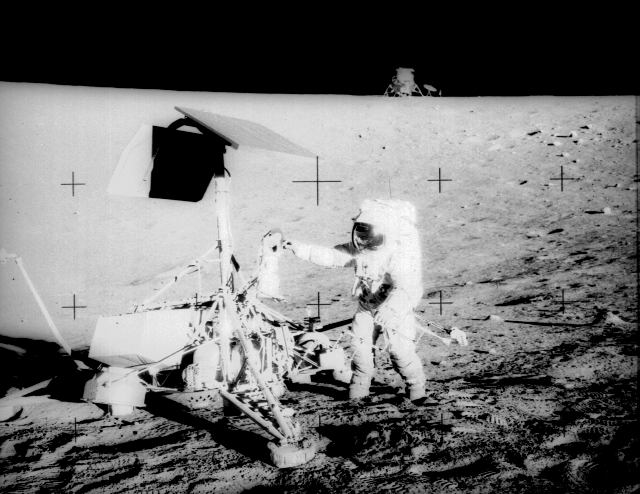
Surveyor 3 was the first spacecraft to
purposefully dig a trench on the Moon.
That doesn't include all the spacecraft that accidentally
dug a trench on impact.
Most people have a poor understanding of the history of Apollo. Their limited knowledge is derived almost exclusively from motion pictures such as Ron Howard's Apollo 13, a movie that, while accurate in most details, left behind a general idea that the only Bad Thing that ever happened on the way to the Moon was the Apollo 13 mission. The movie also gave the impression that Apollo astronauts were merely helpless passengers on a deep space journey, constantly hoping and praying that ground crews would come up with ideas to rescue them.

In fact, NASA's astronauts were not only veteran test pilots, but skilled aeronautical engineers, capable of diagnosing complex electrical systems and flight navigation software. The mission immediately prior to Apollo 13 put these myriad skills to the test in a life or death situation, just moments after launch. And the entire near cataclysm was witnessed by no less an audience than the President of the United States, 43 years ago on November 14, 1969.

The Apollo 12 mission was designed to be the first manned lunar landing with a precise target destination in mind. Unlike Armstrong and Aldrin's goal of merely landing on the flattest part of the Moon, astronauts Pete Conrad and Alan Bean would aim for a 300 square yard touchdown zone near the landing site of the unmanned Surveyor 3 spacecraft. The mission would test the limits of the crew's navigating and piloting skills, as well as the hardware's computing and event handling abilities.

Cmdr. Pete Conrad was arguably the best choice to lead this mission. The veteran naval aviator and test pilot had previously crewed the long-duration Gemini 5 mission, as well as the Gemini 11 Agena docking mission, a flight that briefly made Conrad and copilot Richard Gordon record holders for having traveled farthest from planet Earth. Conrad was a comedian and a prankster, but he also had a reputation for keeping a cool head and working through problems, even during the most dire emergencies. He was reliable when situations were no longer "nominal."

Don't disappoint the President.
Launch weather on the morning of Apollo 12's scheduled liftoff was hardly nominal. An advancing front had pushed a low cloud deck over Merritt Island during the evening, and set visibility conditions at the brink of flight rule acceptability. Unfortunately for NASA, politics sometimes trumped caution. President Richard Nixon, Chief Executive of the United States and holder of the Pen of Budget Appropriations Approval was in town for the launch that day, and to disappoint someone who was in charge of deciding the future of the agency would be an unwise move. So, despite the dodgy weather, the all-Navy crew was loaded into the 365-ft tall Saturn V and the countdown continued in the rain.

At T-0:00, with 7.5 million pounds of thrust, Apollo 12 thundered off the launch pad into the clouds. Just thirty seconds later, the ship would go transonic, pushing through maximum aerodynamic pressure inside the storm.
Launch commit... liftoff!
 Thirty six and one half seconds into the flight, the Something Bad part happened. Here's a transcript:

000:00:37 Gordon (onboard): What the hell was that?
000:00:38 Conrad (onboard): Huh?
000:00:39 Gordon (onboard): I lost a whole bunch of stuff; I don't know.

What happened was that a bolt of lightning seared through the clouds and the spacecraft, riding the trail of rocket vapor back to the launch pad. A second bolt of lightning repeated the journey a few seconds later.

000:00:50 Gordon (onboard): I can't see; there's something wrong.
000:00:51 Conrad (onboard): AC Bus 1 light, all the fuel cells-
000:00:56 Conrad (onboard): I just lost the platform.

Conrad was looking at a mess on his control panel. Every possible alarm signal was lit. The entire electrical system, previously being powered by fuel cells in the Apollo Service Module, seemed to be out. The navigation system (the pilots' familiar 8-ball) was spinning endlessly in a useless gimbal lock. And still the ship hadn't exploded... yet. Either the alarms were wrong or they were about to experience the first out-of-control Moonship. Conrad briefly explained the situation to Mission Control.

000:01:02 Conrad: Okay, we just lost the platform, gang. I don't know what happened here; we had everything in the world drop out.

Gordon, the Command Module Pilot, didn't think it was a hardware problem, but he wasn't sure what to do about the instrumentation problem.

000:01:09 Gordon (onboard): I can't - There's nothing I can tell is wrong, Pete.

000:01:12 Conrad: I got three fuel cell lights, an AC bus light, a fuel cell disconnect, AC bus overload 1 and 2, Main Bus A and B out.

This was no way to get to the Moon. Apollo 12 hadn't reached orbit yet - - they still were low enough to use their Launch Escape Tower and abort the mission. Conrad fingered the abort handle on the arm of his chair and pondered options.
Artist - astronaut Al Bean's interpretation of that moment.
 In the right-hand seat, Lunar Module Pilot Al Bean noodled through the dials on his side of the ship. Bean spotted a voltage indicator from the fuel cells that showed there was still energy in the system.  
000:01:21 Bean (onboard): I got AC.
000:01:22 Conrad (onboard): We got AC?
000:01:23 Bean (onboard): Yes.
000:01:24 Conrad (onboard): Maybe it's just the indicator. What do you got on the main bus?
000:01:26 Bean (onboard): Main bus is - The volt indicated is 24 volts.

Twenty four volts wasn't enough to run the mission, but it also meant that the electricity might be shorting out somewhere in the panel or in one of the circuits. The question was how to isolate the electrical problem without detonating the tons of fuel just behind them that was in the process of shoving them toward the Moon.
  
EECOM and veteran chain smoker John Aaron.
In Houston, a  NASA physics major named John Aaron suddenly realized this scenario was somewhat familiar. Aaron was the Electrical, Environmental and Consumables Manager (EECOM) for this flight, and he had seen a launch problem like this during a mission simulation back in 1968. The problem was that the primary equipment used to convert hardware electrical loads to power levels that could be read by the monitoring dials (known as "signal conditioning equipment") was broken. Fortunately, Apollo was equipped with backup, auxiliary equipment. Aaron knew the problems with all the different system alarms could be fixed with the flick of a switch. Aaron keyed his microphone to talk to CAPCOM Gerry Carr. "Try SCE to AUX," he said.

Astronaut CAPCOM Gerry Carr had no idea what that sentence meant. Neither did Flight Director Gerry Griffith, serving as Flight Director on his very first mission. "Tell them that," he told Carr.


000:01:36 Carr: Apollo 12, Houston. Try SCE to auxiliary. Over.
000:01:39 Conrad: Try FCE to Auxiliary. What the hell is that?
000:01:41 Conrad: NCE to auxiliary...

Carr corrected Conrad:

000:01:43 Carr: SCE, SCE to auxiliary.

Conrad also never heard that command before this mission. Fortunately, Al Bean knew what they were talking about. Bean had been part of the same simulation run that John Aaron remembered, and knew where the switch was on the many confusing panels of the Command Module. Al turned the switch, and the control panel reset itself. 

000:01:48 Bean (onboard): It looks - Everything looks good.
000:01:50 Conrad (onboard): SCE to Aux.
000:01:52 Gordon (onboard): The GDC is good.

Guidance and telemetry were back online, or rather, the astronauts were now able to see what Guidance and telemetry was trying to tell them. Conrad didn't have to pull the abort handle and stop the mission. Immediate crisis averted, they finally had time to take in what had just happened:
000:06:43 Gordon (onboard): Man, oh man ...
000:06:44 Bean (onboard): Isn't that a ...
000:06:45 Conrad (onboard): Wasn't that a Sim[ulation] they ever gave us?
000:06:46 Gordon (onboard): Jesus!
000:06:50 Conrad (onboard): [Laughter].
000:06:51 Gordon (onboard): That was something else. I never saw so many...
000:06:52 Conrad (onboard): [Laughter].
000:06:54 Gordon (onboard): ...There were so many lights up there, I couldn't even read them all.
000:06:55 Conrad (onboard): [Laughter].
000:06:57 Gordon (onboard): There was no sense reading them because there was - I was - I was looking at this; Al was looking over there ...
000:07:02 Conrad (onboard): Everything looked great [laughter] except we had all the lights on...
High-speed  launchpad cameras revealed the twin lightning strikes
that nearly wrecked the mission.

An amazing, terrifying moment that could have easily ended in failure, or tragedy. Instead, the training and skill of the crew and support staff managed to avert disaster. Oh, and they did manage to land right next to that Surveyor spacecraft just five days later.
Mission Accomplished

Me and Captain Girlfriend with
CAPCOM Gerry Carr, who later flew on Skylab 4


Saturday, October 27, 2012

A Fistful of Redstones

Fifty-one years ago today, on October 27th, 1961, the largest flying machine ever built by Wernher von Braun's rocket scientists to date smashed into a million pieces two hundred and fourteen miles southeast of Cape Canaveral. This event marked a veritable victory lap for von Braun's team, and also signaled the end of a technological battle between two branches of the United States military.

Don't you love stories that start out this way? I know I do. Let's back up a bit and go over the details.

Military Missiles

After the end of World War II, the three major branches of the military were crazy for establishing missile superiority - - not with other countries, but between the other branches of the US military. The Army led the development race, building Inter-Regional Ballistic Missiles (IRBMs) such as the Redstone and Corporal rockets under the guidance of von Braun's Peenemuende team. The Air Force, denied the benefits of Operation Paperclip, built their own Goddard-derived rockets in the Atlas and Titan series. The Navy, having no budget for a big missile development program, concentrated on their tiny Vanguard missile program.
Picking the next generation of missiles was a matter of using what worked already.
 The success of von Braun's Jupiter rocket after the failure of the Vanguard rocket as a response to the launch of Sputnik put the Army's Redstone / von Braun team in the prime position to build future heavy-lift launch vehicles. The main restraint was that there was still a branch limitation on long-distance rocketry. The Army could still build interregional rockets, but the Air Force's Ballistic Missile Division was the only organization allowed to negotiate for boosters capable of intercontinental or orbital reach. Even after the Redstone group was assigned to the civilian NASA organization, the Air Force restrictions stood in place.

Wernher von Braun's team knew that the next generation of heavy lift vehicles would require multiple stages - - but the upper stages would have to be designed with the mandates of the Air Force in mind. Since upper stages would probably need to be designed around the Air Force's Titan booster, the next generation of the Army's first stage would need to be able to accommodate the Titan's 120-inch wide frame.

What von Braun's team didn't know was that the Air Force was working on a secretly-designed second stage named Centaur. Centaur would be fueled with liquid hydrogen (LH2), the most efficient fuel known to rocket scientists. The problem with LH2 is that although it's efficient, it's not very dense, so the requirements for fuel tank sizes would be significantly larger than the original planned Titan upper stages. In order to accommodate the Centaur upper stage, the von Braun team's new first stage would need to support a 160" diameter frame.

The USAF Centaur was also supposed to power the X-20 Dyna-Soar space glider.
The Huntsville team managed to rework the design of their heavy lift booster to meet the new requirement by wrapping eight Redstone tanks around a central Jupiter tank assembly. The new vehicle, first named Juno V and then Saturn I, would launch with eight Rocketdyne H-1 engines capable of delivering a total thrust of 1.5 million pounds of force. The eight Redstone tanks, plus the Jupiter core were known technologies, so redesigns of new tanks and feed mechanisms weren't necessary. The slight weight disadvantage of multiple tanks had a tremendous offset in multi-year development costs that were avoided.
Wrap a Jupiter rocket with eight Redstones? That's a Saturn I.
 

 Barging In

 The Huntsville rocket scientist slapped together a Saturn I booster in no time, and ready for launch in early 1961. A static test at the Redstone Arsenal broke windows eight miles away from the test stand. The booster was too large to be transported by rail, so the Saturn would travel by barge to Cape Canaveral. In a pre-GPS world, the barge ran into some literal snags, as nautical maps were not accurate enough to note sand bars and shallows along the Gulf Coast route. After un-beaching the barge on several occasions, the Saturn I arrived at Pad 34 in August of 1961.
Heading for Cape Canaveral aboard the barge Compromise. Managed to beach itself four times.


One downside of the Huntsville crew's speed in construction was that the Air Force's upper stage (now called the S-IV) was nowhere near launch-ready in its development process. NASA decided to build a dummy upper stage, filling the large empty tank with water ballast equal to the proposed weight of the S-IV.
A working S-IV upper stage wouldn't be available for launch until 1964.
 On the morning of October 26th, 1961, the launch operations crew filled the nine tank assemblies with RP-1 kerosene and liquid oxygen. The only delay in the entire process was a brief hold for clouds and winds that would affect photography. After a one-hour delay, all holds were cleared, and the folks in the blockhouse ignited the eight solid propellent gas generator (SPGG) motors, that fired the liquid fuel pumps and started the H-1 engines. Saturn SA-1 lifted off the Pad 34 "milk stool" and headed out over the Atlantic, reaching an altitude of 84.6 miles only four minutes and nine seconds later. The water ballast accelerated to 3,611 mph before falling back to the ocean in an arc that stretched two hundred miles from Cape Canaveral.
We have liftoff, 27 October 1961, 12:30pm ET

Except for an early engine cutoff due to an underfilling of the tanks, the flight was flawless. The von Braun team displayed a mastery of heavy lift launch systems that would not be superseded by the Air Force ballistic missile group in building the way to the Moon landings.
After the success of SA-1, Saturn was the only way to the Moon for JFK.
 Pad 34 would become the initial platform for Apollo-Saturn development flights, and would provide key data for the follow-on Saturn V Moon ships. And all that work began fifty-one years ago today.
You can visit Pad 34 today on the Kennedy Space Center tour. The milk stool still stands.


Thursday, September 27, 2012

Man in the Middle

There's a chain of scientists and astronomers, from Copernicus to Newton, who figured out how the Solar System works. Today (September 28th) is the birthday of a guy who frequently gets left out of the chain, namely because he got part of the workings right and another part of it completely wrong. So, let's focus on him a little bit too much now, shall we?

Ismaël Boulliau, or Ismaël Bullialdus as he's called in his writings, was a French guy born in 1605. He was from a Calvinist family, so that meant he didn't have to worry too much about upsetting Papal authorities with new ideas about the heavens. His dad, an amateur astronomer, got young Ismaël interested in the latest theories about orbits and planetary motion.

Despite his Calvinist upbringing, Ismaël converted to Catholicism and became a priest at age 26. Fr. Bullialdus wound up working in the Royal Library in Paris, reading, sorting, and purchasing books for Louis XIII's court. King Louis was big on funding the arts and sciences, so Fr. Bullialdus was a busy guy for library acquisitions.

Ismaël continued the astronomy studies sparked by his father, and due to his position in the upper ranks of the government, became friends with other astronomers and mathematicians such as  Christiaan Huygens, Blaise Pascal, and Pierre Gassendi (all of whom were visitors to the royal court).  These men were on the cutting edge of planetary motion theories, and their correspondence shaped the investigations made by astronomers throughout Europe.

One of the hottest theories about planetary motion was made by a fellow astronomer in Germany at about the same time all these French guys were writing each other. Johannes Kepler figured out that the planets didn't move in circles around the Sun (as the astronomer Copernicus had theorized) but in a path of ellipses, with the Sun located on one focal point of the ellipse. Kepler wasn't sure what force caused the planets to move around the Sun in this manner, but he was pretty certain that the force was inversely proportional to the distance of a planet to the Sun.

Fr. Bullialdus was intrigued, but Kepler's numbers didn't add up. It seemed as though this mysterious force (if it did exist) would operate similar to how light and sound did with distance: namely, that the force would fade not by the inverse of the distance, but by the inverse of the distance, squared. When Bullialdus plugged in the numbers using his own formulas, the motions seemed to work just fine. Fr. Bullialdus published his findings in a book he called Astronomia philolaica, which appeared in 1645.

So, in 1645 Bullialdus had written this book that accurately described the motions of the planets. Unfortunately, he spent the second half of the book refuting the idea that some kind of "force" existed to make the planets go around the Sun. Instead, Ismaël believed the Sun and the planets were rolling around in the sky because of their initial trajectories at the beginning of the Universe. Fr. Bullialdus wrote, "I say that the Sun is moved by its own form around its axis, by which form it was ignited and made light, indeed I say that no kind of motion presses upon the remaining planets." Despite mathematical evidence to the contrary, he refused to apply the clues to discover the laws of gravity.

Thirty-eight years later, Sir Issac Newton would take the clues left by Bullialdus in Astronomia philolaica in order to shape his own book, the Principia Mathematica. Newton noted in the foreword to his book that Bullialdus's math was right on the money. However, Newton (and rival Robert Hooke) both managed to take the next step and specify that gravity was a predictable force in the Universe.

Tough break for Fr. Bullialdus. He retired to Abbey St. Victor, where he lived out his final years as a simple priest. On the plus side, today he's got a crater named after him - - if you have clear skies tonight, the sunlight should just be hitting his crater in the middle of the Sea of Clouds. Easy to spot - it's got a tiny peak in the middle that casts a shadow on lunar mornings.  So, maybe go out and take a look at the Moon tonight, and think of the fellow who had all the pieces, but didn't solve the puzzle.


Wednesday, September 12, 2012

Not Because They are Easy, but Because They are Hard

Nuno Bettencourt was the lyricist and frontman for the 80's rock band, Extreme. He wrote lots of glam metal rock ballads, but achieved his greatest success with an acoustic pop song.

Bettencourt felt that the phrase "I love you" was becoming meaningless. In a 1991 interview with the Albany Herald, he said, "People use it so easily and so lightly that they think you can say that and fix everything, or you can say that and everything's OK. Sometimes you have to do more and you have to show it – there's other ways to say 'I love you.'"  The result was the hit song More Than Words.

True, words can be meaningless if not backed up with actions, but sometimes words spark and inspire enormous actions.

Today marks the 50th anniversary of a speech that defined and explained the reasons why America decided to go to the Moon. President John F. Kennedy, speaking to a class of future engineers and scientists at Rice University, stood at a podium in the middle of a football stadium on a hot September morning and summarized the history and mission of American explorers. The scope was huge, covering 50,000 years in the first two minutes of the speech, then continuing through the period from the establishment of the Plymouth Bay Colony by William Bradford, and extending to the investigations of the Moon and the planets beyond which continues a half-century later.

Historians can point to a handful of Presidential addresses that encapsulate a moment in time clearly and succinctly. Abraham Lincoln, penning thoughts about the dedication of a national cemetery, summarized the reasons for the Civil War and its higher purposes in the 262 words that form the Gettysburg Address. Franklin Roosevelt, responding to a surprise attack by an enemy on the other side of the planet, formulated a speech that marked the Pearl Harbor assault as a "day of infamy" forever.

The Rice University speech by President Kennedy is undoubtedly on a par with these other historic addresses. JFK spoke not only to the Rice students, but to America and the world:

William Bradford, speaking in 1630 of the founding of the Plymouth Bay Colony, said that all great and honorable actions are accompanied with great difficulties, and both must be enterprised and overcome with answerable courage.
The simple idea here is that going to the Moon is nothing new - - Americans have worked on tough projects before, and will do so in the future. Tying the Space Age to the founding of the country explained this new reach to the unknown as a familiar habit for the nation.
 If this capsule history of our progress teaches us anything, it is that man, in his quest for knowledge and progress, is determined and cannot be deterred. The exploration of space will go ahead, whether we join in it or not, and it is one of the great adventures of all time, and no nation which expects to be the leader of other nations can expect to stay behind in the race for space.

Those who came before us made certain that this country rode the first waves of the industrial revolutions, the first waves of modern invention, and the first wave of nuclear power, and this generation does not intend to founder in the backwash of the coming age of space.
 Remember, at the time of this speech, the Soviet Union was far ahead of America in manned spaceflight. They had spent more than several days in space - our three manned orbital flights totaled less than 12 hours. The sense of behind-ness rankled the nation.
We mean to be a part of it--we mean to lead it. For the eyes of the world now look into space, to the moon and to the planets beyond, and we have vowed that we shall not see it governed by a hostile flag of conquest, but by a banner of freedom and peace. We have vowed that we shall not see space filled with weapons of mass destruction, but with instruments of knowledge and understanding.
Kennedy continued the comparison between our conflict with the Soviets on Earth, and the new, unconquered frontier of space:
There is no strife, no prejudice, no national conflict in outer space as yet. Its hazards are hostile to us all. Its conquest deserves the best of all mankind, and its opportunity for peaceful cooperation that may  never come again.
The President then put out the Big Questions of the thesis:
But why, some say, the moon? Why choose this as our goal? And they may well ask why climb the highest mountain? Why, 35 years ago, fly the Atlantic?
On the trip into Houston - - realizing his audience -- Kennedy penciled in an additional Big Question:
Why does Rice play Texas?
And then he answered those questions with an epic response that will probably be quoted as long as Americans travel into space:
We choose to go to the Moon.
We choose to go to the Moon in this decade and do the other things, not because they are easy, but because they are hard.
Because that goal will serve to organize and measure the best of our energies and skills, Because that challenge is one that we are willing to accept, one we are unwilling to postpone, and one which we intend to win, and the others, too. 
 Bettencourt was right that actions are more important than words. But I think, sometimes, the words matter, too.
JFK's podium copy of the Rice Speech, @ the JFK Library
2,503 days after the speech.

Thursday, February 16, 2012

Some things never change

One of the best parts of living in The Future is that things I'd normally have to go to a library to do I can now do while couch-surfing on my laptop at home.

When I was a kid, I used to haunt the basement of my local public library, perusing the stacks of old magazines and newspapers. It was fascinating to read the letters columns of popular science magazines such as, well, Popular Science, and see what the subscriber base at the time thought of Things to Come.

I remember reading this particular letter to the editor from October of 1949, and I managed to find it again, online!

Not sure what R. Klingbeil's life was like after 1949. A Google search shows a "Klingbeil Shoe Labs" from Queens doing quite a healthy business in ice skating equipment today. I hope Klingbeil got to see Sputnik flash overhead only a decade after this note was published.

Funny, or maybe sad - - I had a similar discussion with someone about this same topic on a pier at the Banana River in Florida. We were both waiting for the final launch of Space Shuttle Discovery. I was amazed that the concept of how orbits work still evades the minds of many people currently living in the Space Age. How is this possible?

Saturday, January 14, 2012

When I Heard the Learn'd Astronomer...

Captain Girlfriend and I went to a nearby library today for a lecture about Apollo 11. The fellow giving the lecture was a retired engineer who worked at MIT's Instrumentation Lab. He helped design the alignment telescope used in the Lunar Module.

Here's a picture of what the alignment telescope looked like inside the LM:


That camera looking thing behind the yellow guard rail was the Alignment Optical Telescope. It was a critical piece of hardware used to figure out where the Lunar Module was in relation to the Earth and the Moon. By pointing the telescope at two bright stars, the guidance computer could figure out where the ship was located in space. Quite an amazing bit of machinery that's often forgotten when looking at all the marvelous Apollo equipment developed during the same project.

The telescope and associated software cost $15 million for each unit delivered. The speaker told about how, when he was freshly hired at MIT, he was sent to give a demonstration of the new telescope to NASA. His sample telescope was placed on a table near a lectern, and several other engineers from other companies were also given space on the table to present their hardware projects. One of the other engineers got up to explain his system, and bumped into the table. The telescope began rollling... and rolling... and the speaker was sitting TWO ROWS away from catching the thing. Fortunately, nothing wound up broken, and the MIT folks didn't fire him for not wrapping himself around the scope 24/7.

The Q&A session was disappointing. I like going to popular science lectures to hear what average people want to know about, but it's usually quite depressing to think that most people believe the job of NASA is to redirect asteroids that are going to hit the Earth like a Michael Bay movie. The questions were about asteroid redirection, why America is "no longer in space anymore" and whether America would establish a permanent base on an asteroid. It's difficult to have a dialogue about the state of American manned space exploration when so few people actually follow what's in development at NASA. 

An interesting question from a 15-year-old boy in the audience made me realize how little of the Apollo era has translated to the current generation. The young man could not understand how the Apollo parachutes could have survived reentry. I've never noticed this before, but the landing sequence for Apollo really isn't described in much detail in movies about the missions. The engineer did his best to detail the Interface and Entry process in Apollo, but I'm not sure if the boy completely understood. 

After the Q&A, the small crowd broke up into little groups getting ready to leave for home. One family asked me a few questions, as they had heard some of the questions I had asked the engineer. I explained that there were many manufacturers working with NASA on manned spacecraft, and reading sites such as spaceflightnow.com was a great way to find out what's new. Their son (also about 14 or 15) didn't ask questions but seemed very interested in the topic. I can only hope that his curiosity would turn into the passion so many folks my age still have. 

All in all, a fascinating day.

Monday, December 19, 2011

Backyard Lucas

A million billion years ago when I was young, I used to make animated movies - - not the kind with the acetate sheets on a drawing board, but actual 3-D, stop-motion films. With a bucket of Matchbox cars, a Super 8 camera and a cable release (something that the camera guy at Woolworth's couldn't understand: "Why would you need a cable release for a movie camera?"), I'd film stop-motion traffic jams in my backyard as long as the summer afternoon light lasted. Pixelated GI Joes in Mercury spacesuits would be tethered to the "orbiting space platform" that looked an awful lot like the family mailbox out by the curb. Hundreds of feet of processed film epics sit in shoeboxes somewhere in my house, each reel  a short lesson that taught me how to make the next film a little better.

I went to college to learn how to make professional, compelling films. Then I got married, had kids, and found other priorities that crowded out my early desire to tell stories with moving images. I couldn't go back to making films, because I didn't have time or budget to take care of what was more important in my life. Understand that I enjoyed the life that happened instead - - - I didn't think I'd ever be able to go back to making films like I used to.

In the past month, I've found out that there may be a way to make cool movies again. Since I'm now the CEO of a New England high-tech company, I can now experiment with the latest software technologies and equipment. One of these software technologies is the latest release of Adobe's AfterEffects program, a piece of software that comes pretty close to parking Industrial Light & Magic on your desktop. For troglodytes like me, the output from this software is nothing short of breathtaking.

Let me give you a brief idea of the level of coolitude brimming from this software. I ordered a copy of Adobe AfterEffects from Amazon early last week. It arrived Saturday and took about 10 minutes to install on my computer. After looking at a few brief tutorials online, I thought of a test subject to try as a first-go at learning the ins and outs of the program.

Here are the details: NASA's Jet Propulsion Laboratory has been receiving closeup photo data of the Moon from the Lunar Reconnaissance Orbit for more than a year now. Last spring, JPL published a high-resolution Mercator projection photo of the Moon. It looks like this:


One of the cool things Adobe AfterEffects can do is  take a flat picture and wrap it around a 3-D sphere, so that the result can be displayed as a virtual globe. So, I took the hi-res LRO picture, told AfterEffects to wrap it around a sphere, and then I spun the virtual sphere and told AfterEffects to move the virtual camera away from the virtual Moon globe. Here's the result:


That's just from an hour or so of playing with the controls and slapping one NASA pic into the photo asset directory. 

Now, I really *want* to make a short film with this amazing bit of software. First, though, I think I have to make it through Christmas first.

Wednesday, November 23, 2011

Remember Where We Parked!

If you've tried out my two previous blog posts on how to be a Moon map expert, you're now quite ready to be a Certifiable Lunar Historian when it comes to knowing where all the Apollo Lunar Modules landed. It's a snap, because (1) there are only six lunar landing sites and (b) the maria you already know will help you pinpoint the landing sites quite easily.

The Apollo lunar landing missions were numbered 11-17. If you saw the movie, you already know that Apollo 13 wasn't able to land on the Moon, so all we have to think about are the remaining missions: 11,12, 14, 15, 16, and 17.

Everybody knows that Apollo 11 landed in the Sea of Tranquility, and we'll get into more detail about that shortly. Let's split the remaining missions after Apollo 11 into "odds" and "evens" :


So, we've got the even-numbered missions on the lower left, the odd-numbered missions up above, and the Apollo 11 mission right in the middle as sort of a "divider." It's funny, but the layout is pretty darned close to how the actual landings occurred back then.

You know where Apollo 11 landed, right? "Tranquility Base," on the Sea of Tranquility. Let's go back to the Moon map and look at the Sea of Tranquility again:


As you remember, it's right in between the Seas of Serenity and Fertility, right? (STuF). The Sea of Tranquility straddles the Moon's equator, which is fortunate, because Apollo 11 relied on an equatorial orbit when it arrived at the Moon. Landing on the equator would make things a lot easier for fuel consumption and communications back to Earth, so Mission Control picked out a smooth spot on the Sea of Tranquility that's right on the equator. Let's look at the map with an equator drawn on it so you can see where the landing was:


See? Right on the equator, at the bottom left corner of the Sea of Tranquility is where Neil Armstrong and Buzz Aldrin landed. All you have to do to find the landing site when you're looking at the Moon is to find the Sea of Tranquility (which you know how to do already) and then look at the 7 o'clock position of the mare - - THAT'S Apollo 11.

Let's go on to the next two landings, 12 and 14. Both of these ships landed in what's called the "Known Sea" or Mare Cognitum. The reason the sea was named the "Known Sea" is because so many lunar missions (manned and unmanned) arrived on this expanse of flatlands on the west side of the Moon. In fact, part of Apollo 12's mission was to set down next to an earlier unmmaned probe named Surveyor 3, a feat which Pete Conrad and Al Bean achieved in November of 1969:


The landing site for Apollo 12 was right where the Known Sea bumps into the Ocean of Storms, just south of the equator:
Once again, we skip over Apollo 13 because that mission didn't put anyone on the Moon, thank goodness. The next mission, Apollo 14, landed on the east side of the Known Sea, next to a huge, ancient crater called Fra Mauro. This mission was also south of the equator:

The final three Apollo missions were much more ambitious. While the earlier missions were near the equator and aimed for smooth, flat landing targets, the later Apollos were sent to the highlands of the Moon. The Apollo 15, 16, and 17 crews were outfitted with larger fuel capacity LMs, to fly further away from equatorial sites and carry more gear to the surface. They even had lunar rover vehicles with them to extend their surface activity areas. 

I'm going skip Apollo 15 for a moment so we can finish up the even-numbered flights. Apollo 16 landed in a highland area almost 10° south of the equator, near a rugged crater named Descartes. If you draw a line straight south from the bottom of the Sea of Serenity, the Apollo 16 landing site is about even with the north side of the Sea of Nectar:


Apollo 15 and Apollo 17, the only missions north of the equator, have easy-to-remember landing sites because they both landed next to the Sea of Serenity. Apollo 15 set down in-between the Sea of Showers and the Sea of Serenity, in an area called the Hadley-Apennine Mountains. It's really easy to spot if you look right at the middle of the northern half of the Moon.


The final mission landing site, Apollo 17, is as easy to spot as Apollo 15's locale, because it's also stuck at the intersection of two maria. In this case, Apollo 17 landed in the Valley of Taurus-Littrow, where the Sea of Serenity bumps into the Sea of Tranquility: 


And that's it! Just remember that Apollo 11 landed on the equator, all the even-numbered Apollos after that landed to the south and west, and all the odd-numbered missions landed to the north around the Sea of Serenity.

The crew of Apollo 17 left the Moon in December of 1972, and nobody's been back since. Hopefully there will be more landing sites to memorize soon, instead of just the six dots that mark mankind's furthest steps away from Earth.


Thursday, November 10, 2011

Be a Moon Expert! - Part 2

You're half an expert on Moon geography already - - so let's get the rest of the Moon into your head right away.

Quick technical review: the maria are the dark splotches we see on the Moon. The maria are spread out over the whole Moon in an easy-to-remember pattern:

"Five on the East Side,
Five on the West Side,
Two in the Middle
and an Ocean out West"


Last time, we went over the East (right-hand) side of the Moon, where there are FIVE maria: the Sea of Crises in the East, then then three "ity" maria in the middle East (Serenity, Tranquility, and Fertility -- "STuF," remember?), and then the Sea of Nectar, "dripping" at the bottom of the East side of the Moon.

Let's take a look at the Moon again:


Okay, we did the East side, and we'll do the West side - - but first, let's make a note of the two maria
that aren't East or West - - they're right in the middle, see?

Let's pull the Moon out of the background to make it clearer about how these maria straddle the centerline of the Moon:

They're a snap to remember. The north mare is Mare Frigoris - - the Sea of Cold. So, North - - North Pole - Cold, get it?
The second mare is smack dead-center in the middle of the Moon. It's called Mare Vaporum, the Sea of Vapors.


Now, I will tell you the incredibly stupid way I remember the name of this sea: "when you get a head COLD, you put Vicks Vapo-Rub on your chest." I came up with this memory aid when I was 8 years old, and it's been my personal shame to remember things like that for decades. Head Cold (up north where it's cold), then Vapo-Rub on the chest - - middle of the body, middle of the Moon. Sigh. Sad, but it's worked for me since the Apollo days.

Okay - - - remember where all the maria are:

"Five on the East Side,
Five on the West Side,
Two in the Middle
and an Ocean out West"


Let's press on to the West side of the Moon, okay?


Wow, that looks like a lot of maria, doesn't it? Fortunately, most of the dark part of the West side is taken up by the only named "ocean" on the Moon (the "Ocean out West") - - the Oceanus Procellarum, or the Ocean of Storms:


The way to remember the Ocean of Storms is to once again think of a US map - - the biggest ocean the United States bumps up against is the Pacific, which is in the Western part of the US. So, West... Ocean. And since it's the only "ocean" on the Moon, just remember that the name of the only ocean is the Ocean of Storms.

The Ocean of Storms accounts for almost half the "maria-type" surface of the West side of the Moon, so that brings the remaining maria in the West down to a more manageable number. Namely, there are only five more maria to remember. Let's look at the five remaining circles on the map of the Moon:
Okay, that looks like a lot of circles - - but you already know the blue one is the Ocean of Storms, so we just have to get the names of the five orange circles and we're done! Let's clear off the Moon and work on just the shapes:

So the first mare we'll deal with is the big round one at the top of the stack: Mare Imbrium, the Sea of Showers or the Sea of Rain.
There's an easy comparison you can make in your head - - the Ocean of Storms is HUGE. Mare Imbrium isn't as big as the Ocean of Storms, so it's just a "shower," not a "storm." Got it? Showers and Storms.

Okay, so the next mare on the stack is Mare Insularum -- the Sea of Islands.


Think of a rainy island, and you can remember that the islands are surrounded by the Ocean of Storms and the Sea of Showers. Another way to remember that it's a sea of islands is that there are some honking great craters scattered across it, like Copernicus and Kepler. We'll talk about craters next time, but right now just remember that the "islands" in the Sea of Islands are big craters.

This next mare is really difficult to remember, but I've kept it in my head with one of the stupidest metanymic memory aids ever conceived.

Mare Cognitum is the "Sea That Became Known" or The Known Sea. The way I remember this mare is that I *know* the mare below the Island Sea is the Known Sea. Yes, it's meta, but it works for me because I know the Known Sea is under the Island Sea. And now you know, too.

Here we go with the final two maria. As you can see from the places you've already learned, the places on the West side of the Moon seem to be concerned with weather - - storms, showers. The final maria are also about weather: namely, clouds and moisture. The mare on the bottom right is the Sea of Clouds, Mare Nubium.

The other mare is Mare Humorum, the Sea of Moisture.
How to remember these two? Well, on the Moon, "moisture is on the outside of clouds." Easy to see as the Sea of Moisture is closer to the edge of the Moon's horizon than the Sea of Clouds. Additionally, the Sea of Moisture is the lowest mare in the West - and so it's a drippy business, just like the Sea of Nectar, the lowest mare in the East.
Yes, the memory system is all quite infantile, but it seems to stick in the head if you give it enough time. Let's take a final look at where all these maria fit on the lunar surface:


Remember? The head COLD and the VAPO-RUB in the middle of the chest? Then, there's the only big Ocean, like the Pacific on Earth, that's way out to the West and is called the Ocean of Storms. 

Next there's the remaining five maria in the West - - the top one is Showers, which is like the big Ocean of Storms except Showers aren't as big as Storms. And it Showers on the Islands in the Sea of Islands, right in the middle of the West side of the Moon. And under the Island? Well, you KNOW that the Known Sea is under the Island, right? And you also know that the West is full of Clouds and Moisture - - but Moisture is on the OUTSIDE of Clouds on the Moon. Got it? Great!

Here's a look at what you know about the Moon:


"Five on the East Side,
Five on the West Side,
Two in the Middle
and an Ocean out West"

And you can name ALL of the maria now - pretty darned impressive! Next time, we'll go over some quick tips so you'll be able to point out ALL SIX Apollo lunar landing sites like a MOON BOSS. Failure is NOT an option. More soon.


Wednesday, November 9, 2011

You Will Be a Moon Expert in Five Minutes (well, half a Moon Expert)...

Thanks for coming back for the meat-and-potatoes part of the Moon talk. This episode, we'll get the map of the Moon memorized so that the next time you see the Moon in the night sky, you'll be able to impress your friends, family, and passers-by with your insanely-great knowledge of the Moon.

Here's the best part: you'll only have to learn HALF of the map of the Moon to be an expert. Why? You know this already: we on Earth only see one half of the Moon's surface. So, we'll only go over the NEAR side of the Moon. The FAR side - - the side we never see - - is mostly populated by hundreds of thousands of craters, like this:
And it's mostly a bunch of craters with really long Russian names (they were the first around the back of the Moon with a satellite, so hey -- naming rights!) so we'll just skip that part.

Okay, back to the Near side. When we look at the Near side of the Moon, we see mostly dark areas, punctuated by a couple of lighter, dusty cratered areas. Like this:


The dark areas are called by the Italian word for "sea," which is "Mare" (remember Galileo and his telescope? Hey -- naming rights!) The dark areas were given Italian names, and form the major identification structure of where things are on the Moon. It's sort of like talking about continents on Earth.

Now, it looks like there are a lot of mares on the Moon, and that might seem difficult to remember. However, if you break the Moon down into regions, it becomes super-easy to remember what is where on the map of the Moon.


First, a quick note about directions: when you're looking at the Moon in the Northern Hemisphere, north on the Moon is "up," south is "down," west is to the left, and east is to the right. So, let's think about it like this:


The secret to learn the map of the Moon is to learn this ditty about the Moon maria:

"Five on the East Side,
Five on the West Side,
Two in the Middle
and an Ocean out West"

Say it out loud. Don't worry - - nobody will notice. Say it:

"Five on the East Side,
Five on the West Side,
Two in the Middle
and an Ocean out West"

Okay, let's not learn the whole Moon at once - - we'll start with the East side of the Moon:


The East side of the Moon, the part that the New Moon first lights up at the start of the lunar month, has *five* major maria we can spot with the naked eye. Here's a bunch of circles to highlight the five maria:

Let's take the Moon away so we can focus on the maria circles:

So, there's one really circular mare on the upper right, three connected seas in the middle, and then a stretched-out one at the bottom. See the groupings? 1, then 3, then 1 more.

That one circle at the top right is the Sea of CRISES, or Mare Crisium.

See? You've learned the name of a lunar mare. Crises - - think of it as  NEW ENGLAND Crises, and it'll be easy to remember - -because it's waay up in the northeast part of the Moon, like New England is on a map of the United States. Crises - - you've got that one down pat now.
Let's get on with the clump of three. These are the "ITY" seas because their names all finish with "ity." Look:

There's the Sea of Serenity, the Sea of Tranquility (Neil! Buzz!), and the Sea of Fertility. Serenity, Tranquility, Fertility. How to remember this stuff? STUFF. Stuff - that's it! STF - Serenity, Tranquility, Fertility. Think of it as a sandwich - -the STUFF goes in the middle.

Last one on the East side of the Moon is the Sea of Nectar:

Nectar - - how to remember that? Nectar DRIPS down to the bottom, so the Sea of Nectar is at the bottom of the Moon's Eastern maria. The Sea of Nectar is also the oldest mare visible on the Moon, so it's going to be at the BOTTOM of the totem pole when it comes to stacking the maria on a timeline. 

Let's go over those East side maria again: Sea of Crises at the far northeast, then the STUFF in the middle (Serenity, Tranquility, Fertility), and then the dripping Sea of Nectar at the bottom. Done with half the Near side's maria!

We'll bring the map back in for a moment so that you can picture how it looks in the sky with the names (but of course you know these names now so you won't need a reference when you look at the Moon in the sky later, right?)


Isn't it something that you know all these names in your head now? I was going to continue with the west maria, but let's pause here for right now and pick up the west side of the Moon next time. You're doing really well sticking with this post all the way to the bottom! Come back again for the west side.