Showing posts with label Trains. Show all posts

Wednesday, September 26, 2012

It's a Mighty Rough Road from Lynchburg to Danville

I love the past, I love trains, and I love a good, dreadful story. Fortunately for me, this next little tale involves a nasty bit of railroad history that was so famous after it happened, it spawned a folk song.

September 27th marks the 109th anniversary of one of the most awful train wrecks in Virginia history. All the elements of impending doom were easily spotted in hindsight, but the participants failed to notice the obvious perils until they arrived at the accident.

Let's back up a bit. After the Civil War, the economy of the South was ruined for decades. The infrastructure of railroads that had criss-crossed the agrarian terrain had been destroyed by Grant and Sherman as they eviscerated tracks and stations during their military campaigns. Although cities and towns rebuilt quickly, the transportation infrastructure of Dixie had not fully recovered until the first several decades of the Twentieth Century.
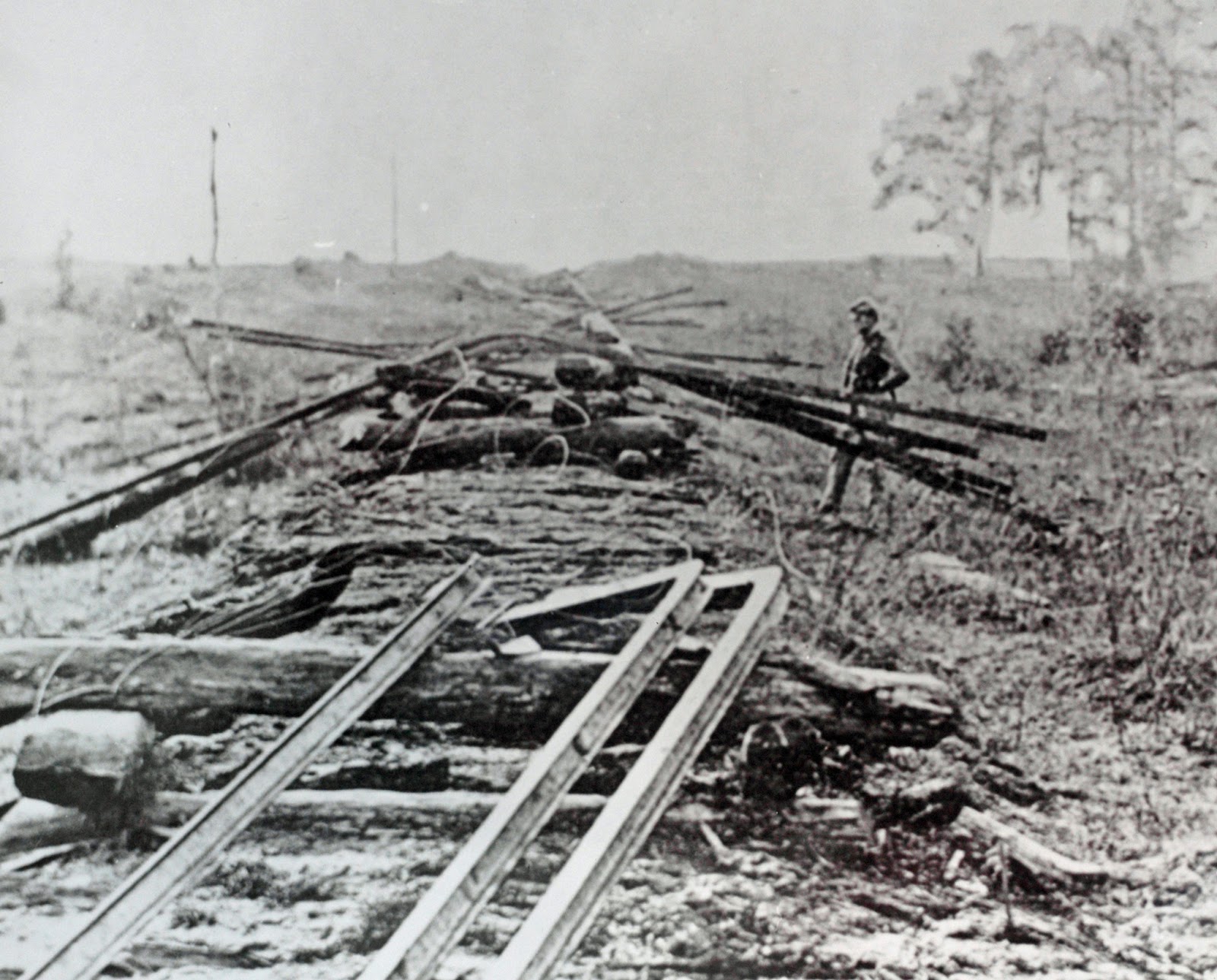
One of "Sherman's Neckties" in Georgia, 1864

Chief among these recovering railroad companies was the Richmond & Danville Railroad.  During Reconstruction, the Richmond and Danville System, as its name implies, rebuilt destroyed right-of-ways throughout Virginia and the Carolinas. The R&D Railroad owners didn't match their construction outlays with their operating income, and found themselves flat broke by 1893. They lost their heavily-mortgaged company to Yankee financier J.P. Morgan, who fired the board of directors, bought up a couple of other railroads in Floria and Georgia, and renamed the company the Southern Railway System.

Morgan's new railroad was a powerhouse, with new rolling stock, new locomotives and state-of-the-art engine shops throughout the South. Morgan appointed Sam Spencer as the company's first President. Spencer was a complete train geek, previously serving as the President of the Baltimore & Ohio Railroad, as well as the Superintendent of the Long Island Railroad before working for Morgan as his chief railroad financial analyst. It was said that Spencer could figure the profitability of a railroad down to the price of the last hand brake or railroad tool shed.

The biggest money maker for railroads at the beginning of the Twentieth Century was "fast freight" - - a particular type of scheduled cargo service that could guarantee delivery to cities by a certain date and time without fail. The biggest customer for this service was the United States Post Office. Successful fast freight providers could earn top dollar from mail contracts with the rich, willing federal government. The only requirement was that the mail would always be on time.

One of the most lucrative mail contracts in the South was the delivery route between Washington, DC, and Atlanta. The train consist that Spencer assigned for this run on the Southern Railway was called the Fast Mail,  made up of two postal cars, one express car, and one baggage car. The loads of mail making the 630-mile run would be hauled by the latest in steam technology, the Baldwin Locomotive Works' 4-6-0 "Ten-Wheeler." The Philadelphia-built Baldwin engine was capable of speeds near 90 mph, making it the ideal locomotive for the fast-freight market.
The Baldwin 4-6-0 Ten-Wheeler


Spencer ordered 28 locomotives of this type from the Baldwin Locomotive Works. His goal was to move Southern away from relying on regional cotton and tobacco hauling, and build more diversified traffic across the system. The mail service was the perfect cargo for Spencer's new business plan.

Understandably, train crews were under a lot of pressure to keep to their schedules. The loss of a mail contract due to delayed delivery was unacceptable, and potentially catastrophic to the railroad company.

I guess you can see where all this is leading.

On September 27th, 1903, the Fast Mail was delayed leaving Washington's B&O Station as it headed toward Atlanta. After further delays in Fredericksburg, the train was more than an hour behind schedule as it neared the central Virginia town of Monroe. At Monroe, a new train crew boarded the late train, and prepared to make up time on the road. While Engineer Joseph Broady and two firemen worked up steam on the engine, about a dozen postal clerks continued sorting mail in the express cars.

Before Broady boarded the locomotive, the dispatcher told the engineer that he needed to get back on schedule by the time he reached Spencer, Virginia - - about 166 miles in front of his train. To do so, Broady would need to get the engine running at least 50 mph for the length of the run - - about 12 mph faster than the typical run through the winding, rolling edge of the Blue Ridge Mountains. To make Spencer on time, Broady was also instructed to continue at speed through Franklin Junction, Virginia, normally a water station stop on the line.

To counteract some of the worst parts of the terrain, the Southern Railway built a series of trestles that connected track grades along the sides of steep hills and valleys. One of these trestles, the 45-foot-tall Stillhouse Trestle, crossed a muddy river at the bottom of a ravine known as the Stillhouse Branch. The trestle was more than a 5% downgrade along its length, and curved sharply on its northern approach. 

The rest was fate and physics.

The Fast Mail locomotive #1102 plunged off the north end of the Stillhouse Trestle, pulling the mail cars with it into the ravine. The engineer, the firemen, the conductor, the flagman, and several of the mail clerks were killed. Seven survivors in the rear cars were severely injured.
The Wreck at Stillhouse Trestle

The Southern Railway blamed Broady for the wreck, failing to heed grade warning and speed restriction signs - - even though witnesses testified that the engineer was acting on orders of the Southern dispatcher. Fortunately (at least in the eyes of the Southern Railway) the federal government retained the Fast Mail service with the railroad, and only fined the company for delays on the mail lost in the ravine.

Baldwin engine #1102 was salvaged from the wreckage, repaired at the Southern shops, and continued in service until 1935. The wreck itself received much newspaper and magazine coverage, due to some of the gory details of the train crew's fate. Engineer Broady's body, for example, was found seared by pressurized steam from the boiler, his one hand grasping the throttle control, while his other hand was wrapped around the whistle's lanyard.

Never to waste good drama, songwriters immediately penned heartfelt ballads about the loss of the Fast Mail train. Rather than using the train's name, they wrote about the mail run by referencing Southern's Fast Mail route number: 97.


Well, they gave him his orders at Monroe, Virginia
Sayin' "Steve you're way behind time
This is not 38, it's old 97
You must put her into Spencer on time."

Then he turned around and said to his black greasy fireman
"Shovel on a little more coal
And when we cross that White Oak Mountain
watch old 97 roll"

But it's a mighty rough road from Lynchburg to Danville
And from Lima it's on a three mile grade
It was on that grade that he lost his air brakes
See what a jump he made

He was goin' down the grade makin' 90 miles an hour
When his whistle broke into a scream
He was found in the wreck with his hand on the throttle
A scalded to death by the steam

Then the telegram come to Washington station
and this is how it read
Oh that brave engineer that run old 97
He's a layin' in old Danville, dead

So now, all you ladies, you better take a warnin'
from this time on and learn
Never speak harsh words to your true lovin' husband
He may leave you and never return


Although President Sam Spencer managed to keep the mail service contract after the wreck, he unfortunately had a meeting with destiny, too. In  November of 1906, Sam and a few friends were on a hunting trip outside of Lynchburg, Virginia when they decided to sleep in their car for the night. So they parked - - on a railroad siding. Their car was demolished by a freight train that had been switched to the wrong track. I guess all that intimate knowledge of the railroad business didn't include the part about parking on railroad tracks being a bad idea.


Friday, October 21, 2011

Standards

Writers are supposed to write for their audience, but I am never quite sure who my audience is. There are many ways to divide an anticipated audience by what they know, and what they don't know. Here's the dividing point for this post:

Four feet, eight and one-half inches.

That measurement automatically means something to a few of my readers (mostly nerdy old guys like me, I'm sure) but will leave most of the audience baffled until I explain the purpose of such a specific distance. Four feet, eight and one-half inches is the standard inside span between two railroad tracks in most of the Western world.

Now, the favored legend of how 4' 8.5" became the standard gauge for railroads is literally Romantic: James Stephenson, the inventor of the locomotive, built his first railroad in old Roman chariot ruts, which also happen to be that magic distance. The pedestrian truth, though, is that coal mining wagons typically used 5'-wide axles. The axles were attached at the outside of the 2"-wide wheels, making the wagon's tread width 4' 8" from the inside of each wheel. Add a 1/4" wiggle room to the rails so the flanges of the wagon wheels could easily turn corners, and -- boom -- a standard gauge is born.


Just because the gauge was "standard" doesn't mean it was universal. By reason of geology or economy, the standard gauge wouldn't fit in places such as mountain railways or winding valleys. The Denver & Rio Grande Western, for example, relied on a 3' gauge for much of its pathways through the Rockies. Many logging railroads of the Northwest chose the 3' gauge in order to slide narrow flatcars around the pine-covered hills.

Sometimes, odd gauges were chosen for defensive reasons. The Soviets, for example, have a gauge of 4' 11 and 5/6" -- which slowed invasions by Germany during two wars. Gauge choices can also be defensive in an economic sense.  Many trolley car lines, fearing hostile takeovers by freight trusts, deliberately built their rail systems in wider gauges, on the premise that their networks would be unappealing to the robber barons.The most common trolley car gauge was five feet, two and one-half inches. It was called the "Pennsy Gauge" because the first trolley lines to adopt the odd width were located in Pennsylvania.

The Pennsy Gauge is still used in, well, Pennsylvania of course (most of their subway and trolley lines use the five-foot-two-plus width). It's also used in the few towns still operating 100-year-old trolley systems -- like New Orleans, for instance.

I was in The Big Easy this past week, and had a chance to be a total rail geek tourist with their trolley system. Sadly, there's no streetcar named Desire anymore - - the Desire Street Line was closed in 1948. There are still three operating lines in the city, though: the Riverfront Line, the Canal St. Line, and the St. Charles Line. St. Charles uses  Perley A. Thomas streetcars built in 1923. Eighty-eight year old street cars still manage to haul over 17,000 passengers every day through the streets of New Orleans.


Here's a picture of two gauges: on the left is the 5' 2.5" Pennsy Trolley gauge, and on the right is the 4' 8.5" standard gauge. The two rails parallel each other on the riverfront, with freight trains taking the rightmost rails and streetcars using the left.


A better view of the wide Pennsy gauge running down the "neutral ground" of the St. Charles median. Very odd and scary to see folks jogging along an active trolley line, but people were using this center grassy strip as both a rail and a trail.

Right out the front window of a St. Charles trolley car. This is the view the motorman sees as he or she negotiates his way through downtown traffic. Quite amazing to see how often cars and trucks turn into the path of an oncoming trolley. The motorman makes frequent use of the trolley bell.


The wide gauge certainly makes for a wide interior. Four across still leaves room for two average-sized people to stand side-by-side in the aisle.


The wooden seats and the brass fixtures are authentic. According to the motorman, they're original to the trolley.

It's a beautiful thing to see a piece of railroad history actually doing a day's work instead of sitting parked in a museum. I'm glad the New Orleans Transit System picked the wide Pennsy gauge to keep these trolley lines from being swallowed up by some now-bankrupt railroad company. That defensive move let me take a ride on a streetcar named St. Charles a whole decade into the 21st Century.

Monday, September 5, 2011

As I was Saying...

Every boy who grew up in New Jersey during the 60's knew about two things: spaceship details and train operations. I've written a lot about the former, but my knowledge of the latter is almost as troubling. Railroads crisscrossed the Garden State and rumbled past everyone's back yards. Locomotives designed by Raymond Loewy back before the Second World War pulled passenger trains faster than anything traveling on the highway today, and coal car trains of 100+ hoppers slogged out of the Pocono Mountains to the power generating plants of the Raritan Valley. Boys all over the state would watch and chase and wave at the passing steel parades from intersections and overpasses.

One of the great advantages of my current gig in Providence is that I can once again watch the operations of a mighty freight / passenger road on the quarter-mile walk to work every morning. Thanks to an as-yet-unmetered stretch of public parking, I leave my pickup truck on the street next to the Northeast Corridor, the great artery of high-speed rail that links Boston and New York City to Philadelphia, Baltimore, and Washington DC. The fastest train in America, the Amtrak Acela, buzzes through Providence morning, noon, and evenings along this route. The Acela is not as inspiring as the old Pennsylvania GG-1 engines that rolled here decades before, but they're a great sight as they start getting up to speed leaving the station.


It's not just the passenger trains that are fascinating. The road is used mostly by the Providence & Worcester Railroad, a surprising survivor past the days of Conrail and CSX. The P&W had an uncanny knack for growth during the 70's, and by avoiding federal aid also avoided federal bankruptcy procedures.


Providence was once an even larger railroad town than it is today. With inbound cargo from their own port and shipments from the port of Boston, a staggering amount of rail freight filled this town a century ago. The American Locomotive Company built more than 3,000 locomotives right where I park my pickup truck today, shipping their products as far west as Australia. The Woonasquatucket and Providence Rivers were bridged and paved over as a solid mass to allow for the many rail lines that needed to cross the rivers, creating what was called "the widest bridge in the world," spanning almost two miles of riverbed.


As rail traffic faded, Providence repurposed the former locomotive plants and removed the massive bridgeworks, revealing the two rivers for the first time in nearly a century. A new shopping mall straddled a small section of the Woonasquatucket River, and the Northeast Corridor was realigned to allow more of the river to see daylight.

Here are a few pictures of the Providence & Worcester railroad, above the restored Woonasquatucket River, and below the Providence Place Mall. The P&W train (pulled by two GP-38 engines) was paused, waiting for the afternoon Acela to clear the Providence station. You can see the engineer watching some mallards on the river.


I have this gig until the end of September. I'm probably going to take way too many pictures of every train I see. Expect more posts on the topic. Thank you for allowing this indulgence.